Blog/Portco GTM
How we increase portco EBITDA with AI-powered ABM
/Benyamin Holley/LinkedIn/Head of GTM
A portco sales team has limited time and expensive touches. Benyamin Holley walks through what an Apero engagement looks like end to end: TAM mapping and a GTM data foundation tiered 1 to 4, then a signal layer across cold email, LinkedIn, ads, and dinners, with pipeline measured by account and tier.
The portco GTM data gap
At most PE-backed portcos, sales payroll is one of the biggest lines on the P&L, and every growth operator is thinking about how to get more leverage out of that investment. On top of that, there's pressure to grow pipeline efficiently during the hold period. That's where the EBITDA case comes from: less wasted rep time and less spend per qualified conversation.
The problem starts when reps prospect off bad or scattered lists spread across 50 Google Sheets instead of a centralized, enriched CRM. Money goes into touches nobody can tie back to pipeline. And there's no foundational GTM data layer underneath any of it, because that usually doesn't get built until fund-level professionalization.
Fixing that starts with loading every approved account and contact into the CRM. Some marketers think that the CRM should have a firewall that only lets in people who have shown some interest. For low-ACV, PLG or founder-led sales, the firewall is fine. But with a small team and a ticket size that justifies outbound, you don't want W-2 man hours spent on accounts the team doesn't agree are good, or spent clicking around a platform outside the CRM. If you're paying an AE a $150k base and expecting them to generate some of their own pipeline, you should spoon-feed them.
In this article I'll walk you through how we approach a holistic, AI-powered ABM motion from the ground up. We use tools like Cursor and Claude Code to put together the GTM data we work with, and agents review the data before anyone uses it. That's how we move faster and with more precision than a typical marketing team or agency. Essentially our job is to generate hand raisers for your sales team to pursue. Most clients start seeing real results between day 30 and 90.
Fig. 01
How the system works
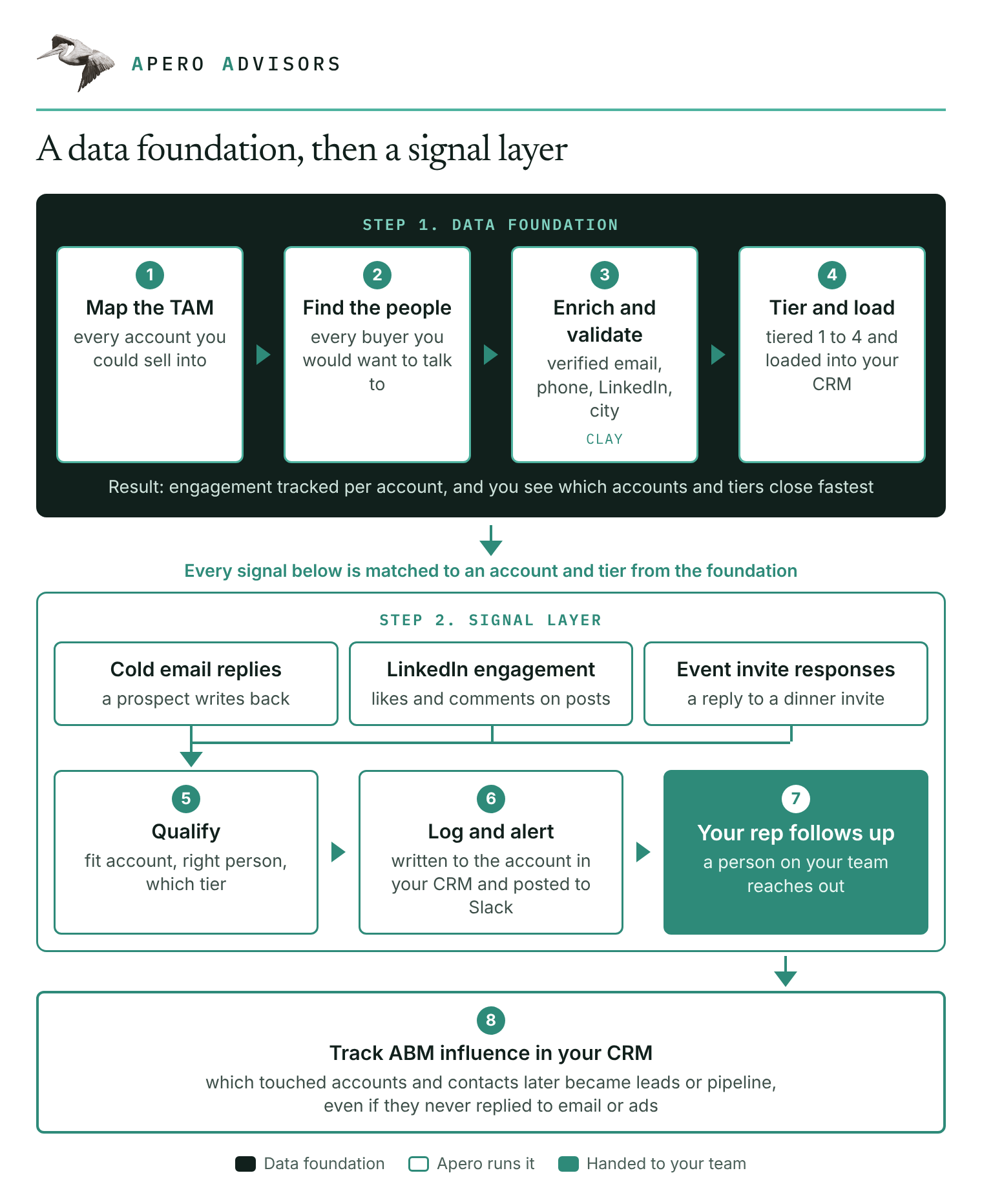
Step 1 is built first. Every step after it leans on the list.
Step 1: the data foundation
This is the most important part, and the part most teams skip. Even the ones who attempted it usually don't know what's actually possible here with modern data enrichment techniques that we use at Apero.
The list is the message. If you're emailing the wrong accounts, no copy will save you. And if targeting is bad you can't figure out the efficacy of channels either. Ever heard "Cold calling doesn't work," and then reviewed the contacts and realized none of them were buyers? All analysis downstream is dependent on this step.
Map the TAM
First we figure out every account a client could realistically sell into, not just the ones that showed up in a database filter. This isn't pulling names out of Apollo. We pull lists from many sources, like Clay, Serper and company websites, dedupe them, and gather the firmographic data points we want on each account. That way lists from different vendors and scrapes become one universe instead of a pile of competing spreadsheets with names like "TAM_EU_final_draft_v2".
Then we qualify. A normal database gives you a URL and a description. If you're lucky maybe a few other data points that haven't been refreshed since 2024. We go in and analyze the website itself to answer the questions that actually decide fit. For example, if a client sells into e-commerce companies, is there a minimum number of SKUs that makes a company a viable target? Job postings help too. What a company is hiring for tells you its tech stack, what it's building and what it's trying to fix right now.
I'm also experimenting with jev for qualifying and disqualifying large datasets. I could write a whole article about that (and I might).
Find the people
For the clients we work with, we then find every buyer and influencer at each account. Lots of teams only load the buyers. That's fine, but reps should have everyone they could ever talk to in the CRM. We scrape company websites for people as well, which matters most in verticals where teams aren't on LinkedIn much. After the initial data dump, we keep refining the list over time as needed, based on what the ABM feedback loop tells us. Data degrades fast, so ideally it gets a refresh every quarter.
Enrich and validate
Next comes verified email, phone, LinkedIn and city for each person, plus context like how long someone has been in seat. Every email is found and then checked by a second, independent validation service.
We also check which mail provider and security gateway sit in front of each company's domain. That tells you whether email will land at all, which domains accept everything (so a "valid" result proves little) or filter heavily, and how to send to them. Take Mimecast, for example. It's very good at filtering bulk mail, so we'd usually skip cold email to those domains and reach them through LinkedIn and calling instead. If someone there should get an email, a rep sends it 1:1.
Agent review, then load
Before anything goes into the client's CRM (HubSpot, Salesforce or whatever they use), agents review it in detail: is the classification backed by a reason, is confidence high enough, does the LinkedIn profile actually match the person, would this overwrite something the client's team already entered? A human approves a preview before each batch loads, and we spend our time on the edge cases instead of on every row.
Tiering decides where the money goes
Every account gets scored and tiered 1 to 4. We could do a whole article on account scoring. For this piece, the short version is that it's a detailed process that's bespoke to each client, and its purpose is to segment how much effort each account gets.
Ideally the exec team approves the tiers. Strategy should be driven top down, but most execs aren't spending their time in Clay tables, so we make sign-off easy. Once leadership signs off, SDR and AE time goes to the accounts the business actually wants.
Fig. 02
Account tiering
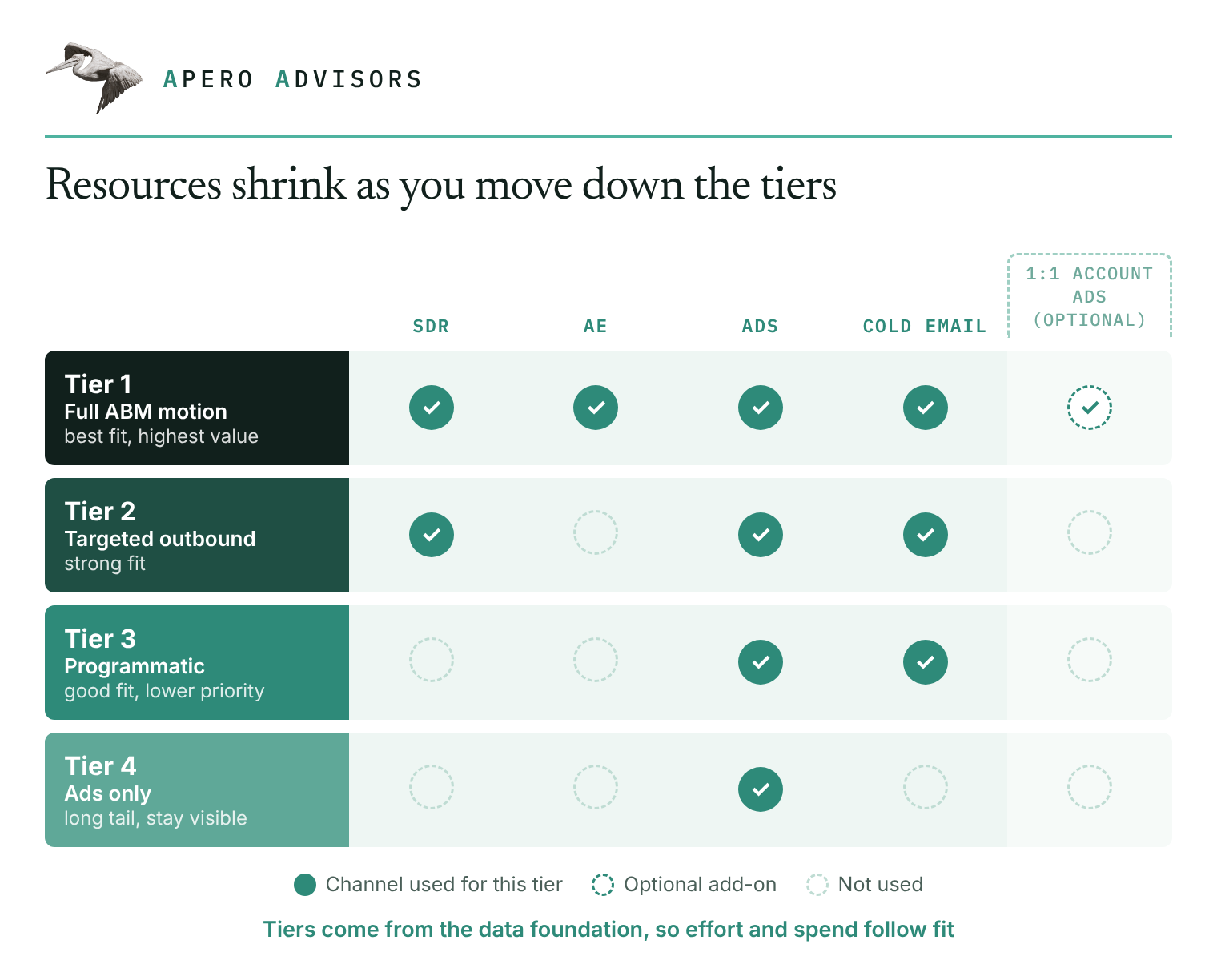
Which channels each tier gets.
Why not just spray and pray?
You might be thinking: this sounds like a lot. Shouldn't we just email and call people?
Of course you should. There's always going to be some spray and pray. But real ABM is spear fishing, not casting a net. Marketing and sales should operate against a narrow set of golden-goose accounts. The expensive, intentional touches (1:1 ads, dinners, and conversion rates we measure and optimize) are reserved for Tier 1. Tier 2 still gets SDR attention and cold email, Tiers 3 and 4 get lighter, programmatic coverage, and beyond that we let them come inbound.
Step 2: the signal layer
The engagements we've been moving toward do the tiering work, then use cold email, LinkedIn DMs and now ads to produce MQLs. Dinners and events run on the same list.
Cold email
Most teams blast big lists from their main domain, land in spam, and burn the domain their real customers email. We do it differently. Sending runs on separate infrastructure that protects the main domain, from inboxes that have been warmed up first. Messages are narrow and segmented by industry, vertical and persona, not one template for everyone. And the hygiene is automated: inboxes that haven't finished warming up get pulled, campaigns with too many bounces get paused, and current customers are suppressed so a cold sequence never hits an account the client already serves.
Fig. 03
Deliverability
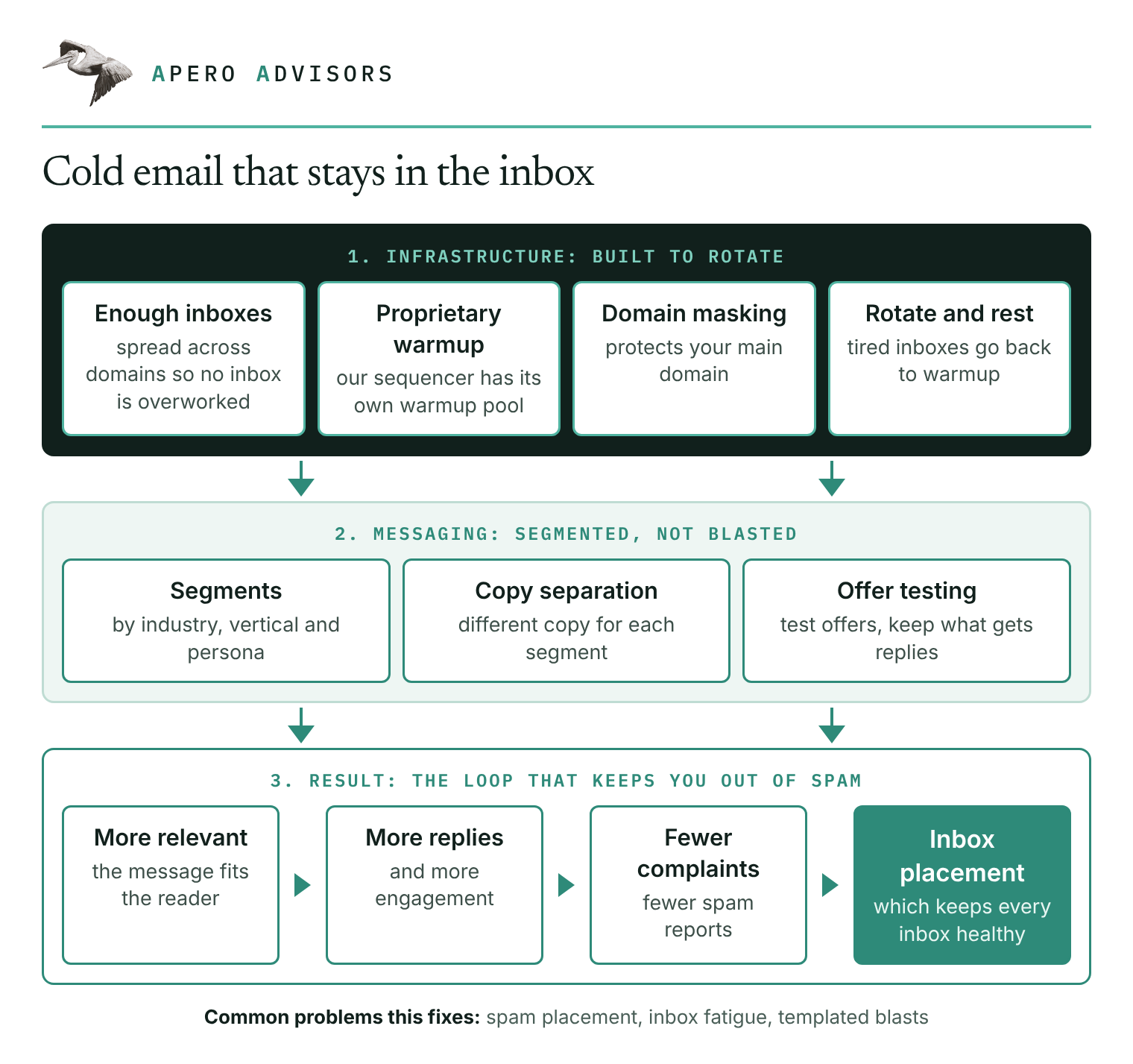
Infrastructure, segmentation and the reply loop.
LinkedIn DMs
Cold LinkedIn DMs run as a single-threaded Lemlist campaign, one more layer of the ABM motion on the same accounts. Alongside that, as one example, we message the people who engage with founder and rep posts.
LinkedIn replies come into Slack too, and we can message responders back from there. So in theory, a single trusted rep can work the founder's LinkedIn without being logged into it, responding to the conversations that went out from the founder's inbox. The founder keeps posting, and the follow-up doesn't depend on them finding time to answer DMs.
Fig. 04
LinkedIn engagement
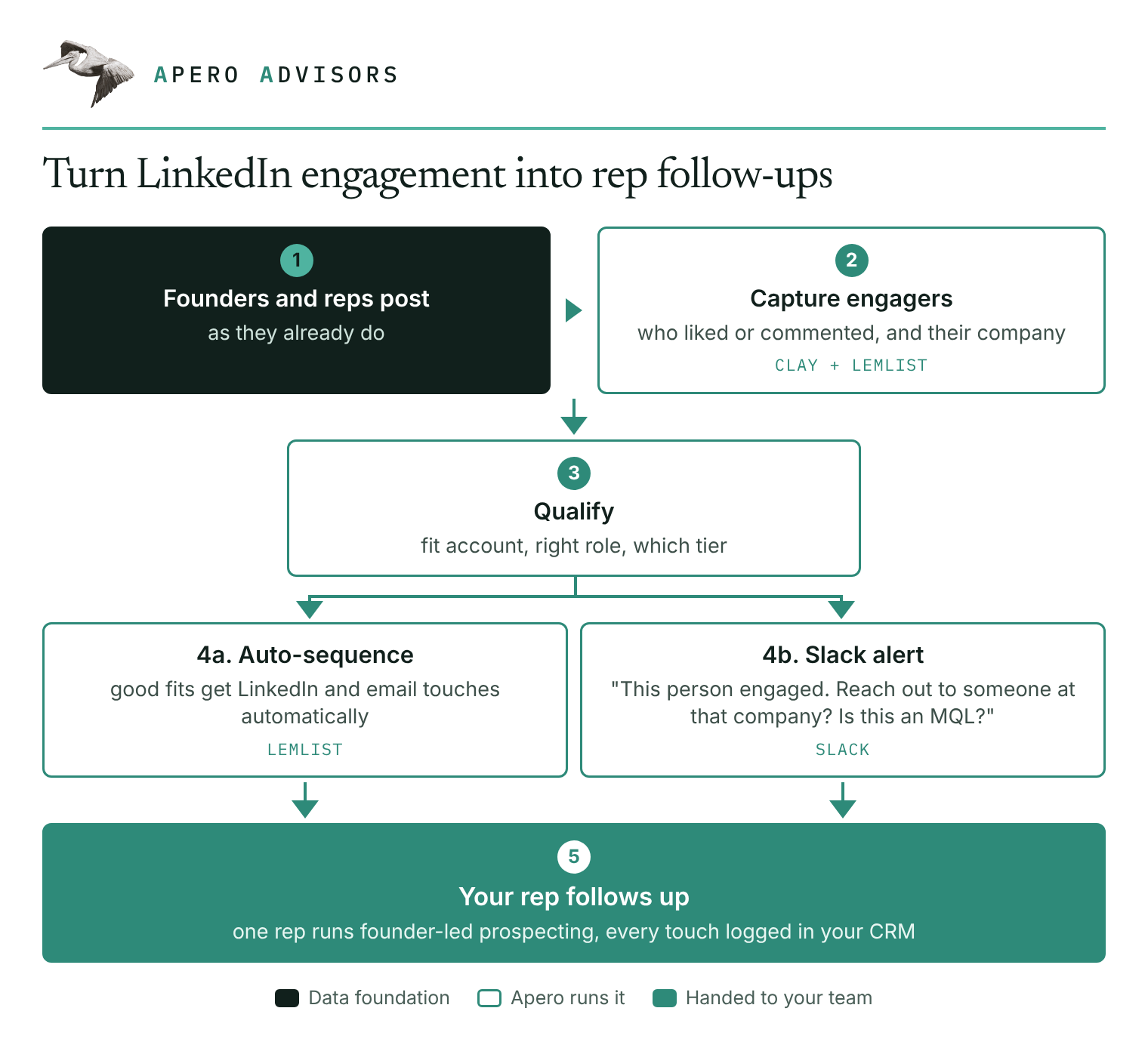
From a like or comment to a rep follow-up.
Ads
We run ads to every tier. On top of that, a rotating subset of Tier 1 accounts, refreshed monthly or quarterly, gets custom 1:1 creative with tight LinkedIn targeting: ads that run to a single account and speak to an issue we think that account has.
Dinners and events
This is where enrich and validate pays off. Every contact has a city, so the invite list for a dinner, or for a conference your reps are already attending, comes straight out of Tier 1. We run the invites and nudges. Your team takes the response.
Fig. 05
Dinners and events
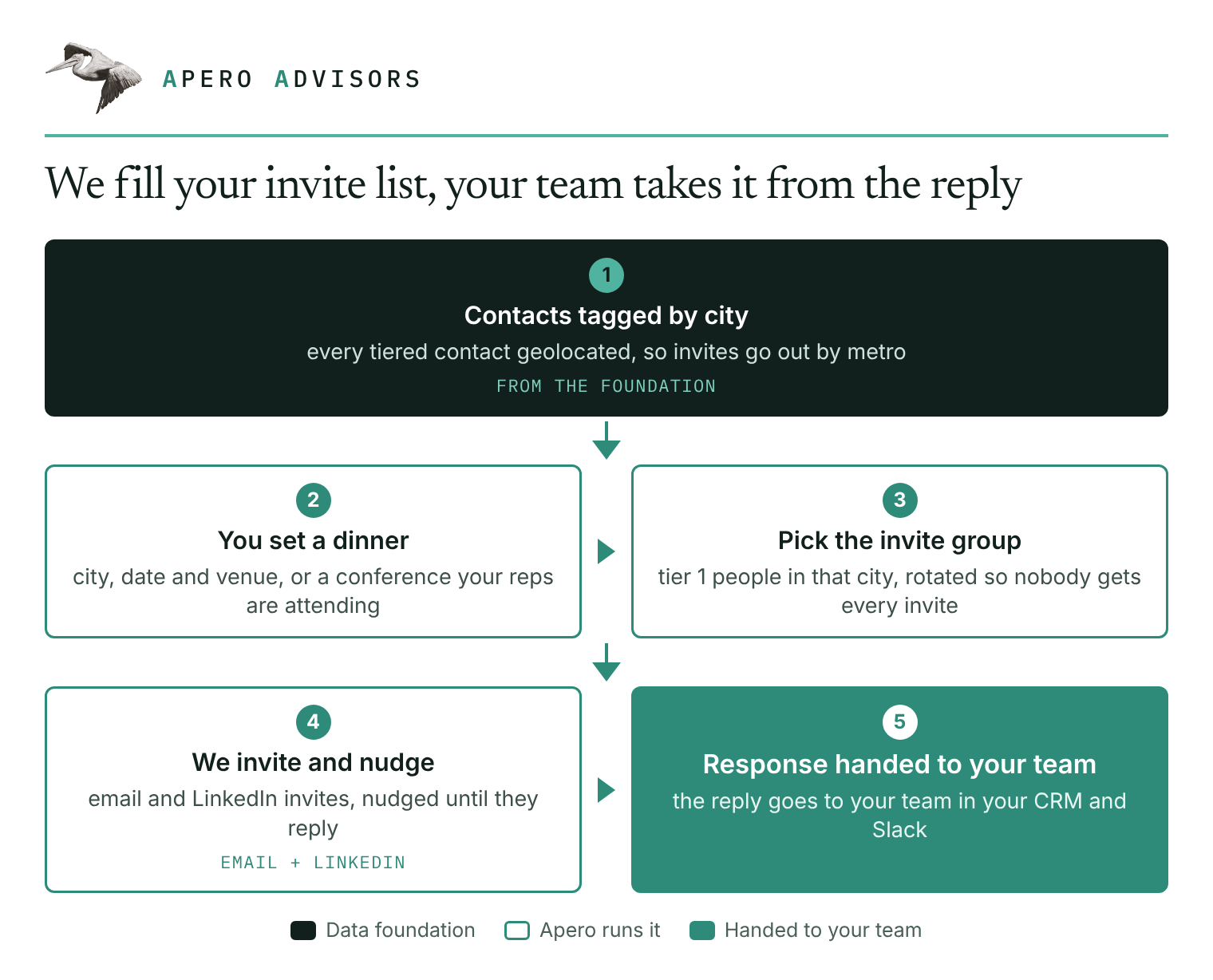
Invites come from Tier 1 contacts in the host city.
Every signal gets matched, qualified, and routed
Every reply, DM, comment or RSVP is tied back to its account and tier from Step 1, so a signal is never just a name floating around in someone's inbox. Junk like auto-replies and unsubscribes gets filtered out. AI reads what's left and decides whether it's real interest, like a meeting ask or genuine questions about the offer. Real interest lands in the CRM and in a Slack alert with the context a rep needs, and a person on the client's team follows up. Nothing auto-sends. We wrote more about using AI on replies in how to build an AI responder for cold outbound.
Call-ready books for reps
The foundation also gives reps something to use on day one: a book of Tier 1 accounts, each with a short dossier, a mapped buying committee and verified contact info, refreshed quarterly or every other month.
For portcos where the founder is still the sales motion, this is how you get selling out of one person's head. More on that in de-risking founder-led sales in lower-middle-market PE.
Fig. 06
Rep books
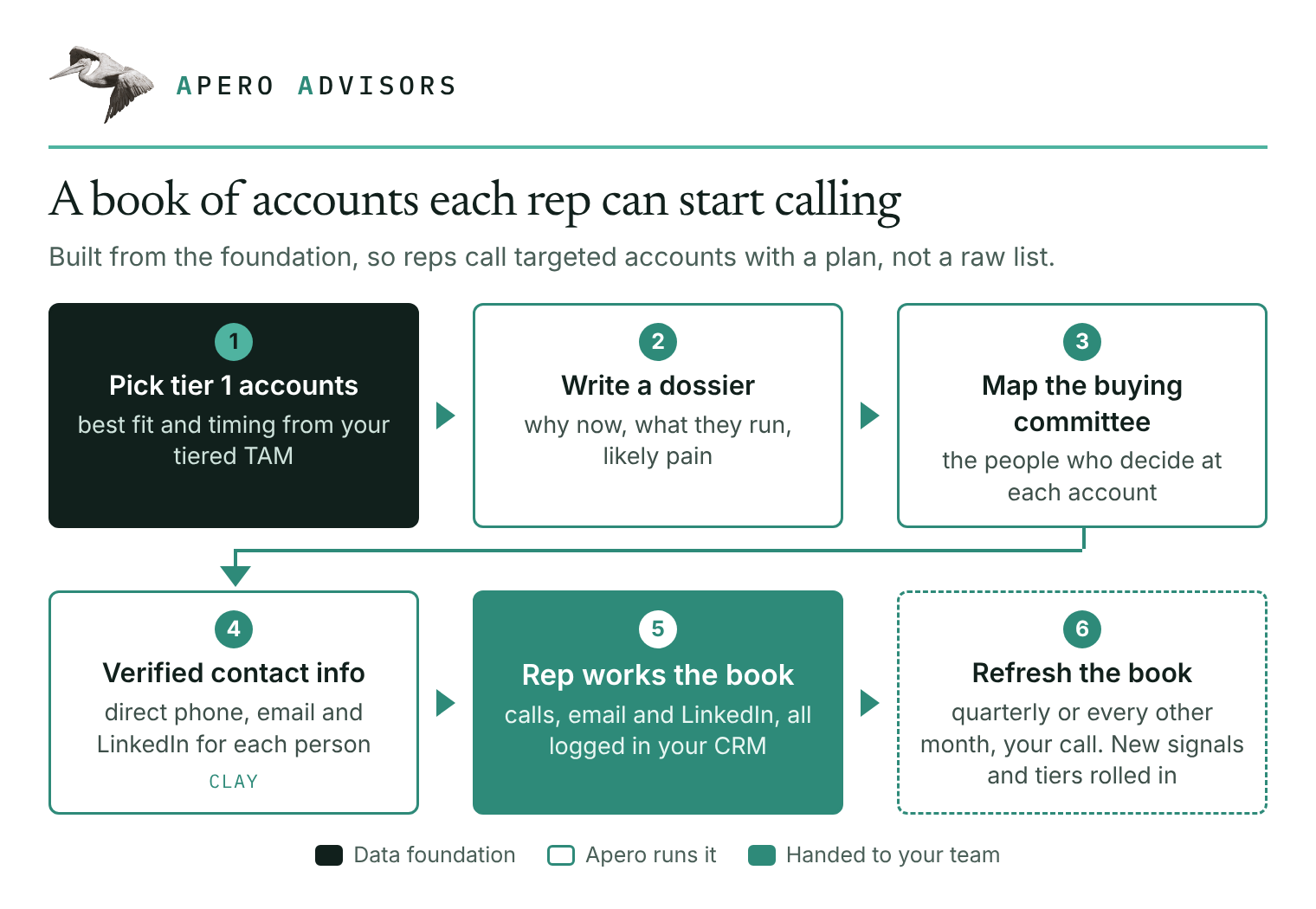
A six-step cycle that repeats each refresh.
The payoff: pipeline by account and tier
This is where the foundation earns its keep. You can see which accounts and tiers close fastest, and you can track ABM influence in the CRM: which touched accounts later became leads or pipeline, even if they never replied to an email or ad.
Ads aside, an ABM motion should be auditable in one CRM. Cold email gets piped in from the sending tools, and the dialer or sales engagement platform should be natively integrated, so phones, emails, programmatic outbound and rep-driven touches all land in one place.
For an operating partner, that's the point. You're not looking at email open rates. You're looking at pipeline by account and tier, which tells you where to put the next dollar of GTM spend and the next hour of rep time.
How the engagement runs
We work embedded or semi-embedded, with dedicated operators, recurring workstreams and a 24-hour response SLA. The model is build, operate, transfer. We build the foundation first, run it week to week, and you can bring any of it in house with docs and training. Engagements are month to month.
If you're running value creation across a portfolio and want to see what this looks like for one of your companies, email ben@aperoadvisors.com or fill out the information below. You can also add me on LinkedIn.
Questions
What is TAM mapping?
Listing every account a company could realistically sell into, then finding the buyers and influencers at each one. It's the first piece of a GTM data foundation.
What is a GTM data foundation?
The account and contact layer every channel runs on: mapped TAM, buying committees, verified contact data and tiers, all in the CRM.
How does AI-powered ABM affect EBITDA at a portfolio company?
Through efficiency, not a promised number: fewer expensive touches wasted on poor-fit accounts, less rep time spent outside the CRM, and pipeline you can measure by account and tier.
How long does it take to see results?
Most of what we set up is done in about 60 days, and most clients start seeing real results between day 30 and 90.
Does the portco keep the system?
Yes, if it wants to. We build it, run it, and hand over any piece with docs and training.
